The Worst AI Chokepoint – and the Stocks Positioned to Solve It
Listen to the audio version of this article (generated by AI).
In Pecos, Texas, Microsoft is building a private power plant.
It’s called Project Kilby. And it sits on more than 2,000 acres in Reeves County – deep in the Permian Basin, the stretch of West Texas that produces more oil and gas than any other region in America.
So much natural gas gets pulled out of the ground here that pipelines can’t always carry it fast enough. Some of it gets burned off as waste. Project Kilby will turn that surplus gas into electricity instead – feeding it straight into one of the largest AI data center campuses in the country.
Chevron will supply the gas. GE Vernova and Caterpillar will supply the turbines to turn that gas into power. At full build-out, the facility will generate 2.67 gigawatts of electricity – enough to power a city the size of Houston.
Project Kilby won’t connect to the Texas grid. Microsoft will own the output entirely. The power will flow straight from the turbines to Microsoft’s data center campus on the same site – a planned complex of servers that will run AI services like its Copilot assistant, used by hundreds of millions of people around the world.
The project carries an estimated price tag of around $7 billion. Microsoft is willing to spend that much to build its own power supply from scratch because the alternative – waiting years for a grid connection – would mean waiting years to scale its AI business.
Right now, a new data center in northern Virginia – home to the largest concentration of data centers in the world – could wait up to seven years to get hooked up to the grid. In other parts of the country, projects filed today may not have power until 2030.
The grid simply wasn’t built for what AI demands of it. Project Kilby is an expensive workaround.
It’s also a signal for investors.
When one of the richest companies in the world decides it’s easier to build a 2.67-gigawatt gas plant in the West Texas desert than wait for a grid hookup, that tells you something important about how serious this constraint has become.
It also points toward a shift in the energy market that represents one of the best investing opportunities of the AI era. Today, I’ll show you where to look – and why the timing may be better than most investors realize.
AI Is Struggling With These Five Chokepoints
To grasp the opportunity, you first need to see the problem.
I’ve written to you here and here about what I call AI chokepoints – physical bottlenecks that threaten America’s ability to stay ahead in the global AI race. There are five major chokepoints:
- High-bandwidth memory – the specialized chips that feed data to AI processors – was sold out through 2026 before the year even began.
- Liquid cooling – the precision-engineered plumbing that keeps AI chips from overheating – has manifolds and distribution units on waitlists stretching into 2027.
- Silicon photonics – the technology that replaces copper data cables with pulses of light, the only way to move data fast enough between AI processors – is seeing demand go nearly vertical as data centers replace their wiring.
- Energy generation – the power plants, gas turbines, and nuclear reactors that generate the electricity AI runs on – is in the middle of the largest capacity crunch since the post-World War II industrial boom.
- Grid and transmission – the transformers, substations, and transmission lines that move power from generators to buildings – has lead times stretching from two to seven years, with some projects effectively stuck in regulatory limbo indefinitely.
Each one is a constraint the AI industry is running into right now. But of all five, energy and the grid are the hardest to fix.
You can solve a chip shortage by building more plants. You can engineer better cooling systems. You can develop faster connectors. But you can’t build a power grid by writing a check. You have to deal with land, permits, federal and state regulators, and transmission infrastructure that in some places hasn’t been meaningfully upgraded in decades.
This hasn’t gone unnoticed by some of the smartest investors in the world.
The Trade That Got Ahead of Itself
When the AI power story broke into the mainstream about two years ago, investors piled into the group that stood to benefit most directly – the independent power producers, or IPPs.
IPPs own fleets of power plants and sell electricity to whoever will pay the most for it. Unlike regulated utilities, which answer to state governments and earn a fixed, approved return, IPPs operate in the open market.
They can take risks regulated utilities won’t touch and charge prices regulated utilities can’t. In a world where the biggest companies on Earth are signing 20-year contracts to lock in power for their AI operations, that’s a valuable position to be in.
The market agreed – emphatically.
From mid-2023 through late 2025, the group climbed sharply. Vistra Energy (VST), one of the largest IPPs in the country, gained more than 500% over a roughly three-year stretch, peaking above $219 a share last September.
Then came the pullback. By mid-May of this year, Vistra had fallen more than 40% from that peak.
Constellation Energy (CEG) and NRG Energy (NRG) followed similar paths – strong gains through 2024 and into 2025, then a sharp retreat that has taken all three to one-year lows.
That kind of pullback in a group with this kind of fundamental tailwind is what patient investors look for. Because the underlying story – surging AI power demand, a grid that can’t keep up, and tech giants signing decade-long contracts to lock in supply – hasn’t changed. If anything, deals like Project Kilby are making it more obvious by the week.
The question is which IPP stocks deserve the closest look and whether the evidence says the time to act is now.
This IPP Is the Standout Play
VST, CEG, and NRG – are in Short-Term Health Red or Yellow Zones. That means they’re in unhealthy short-term downtrends or in an uncertain transition periods between bearish and bullish.
They may well recover – the long-term fundamental case for all three remains intact. But our indicators say now is not the time to step in.
Talen Energy (TLN) is different. It entered a Short-Term Health Green Zone last week, meaning its short-term trends are pointing up. That’s the signal we look for before acting.
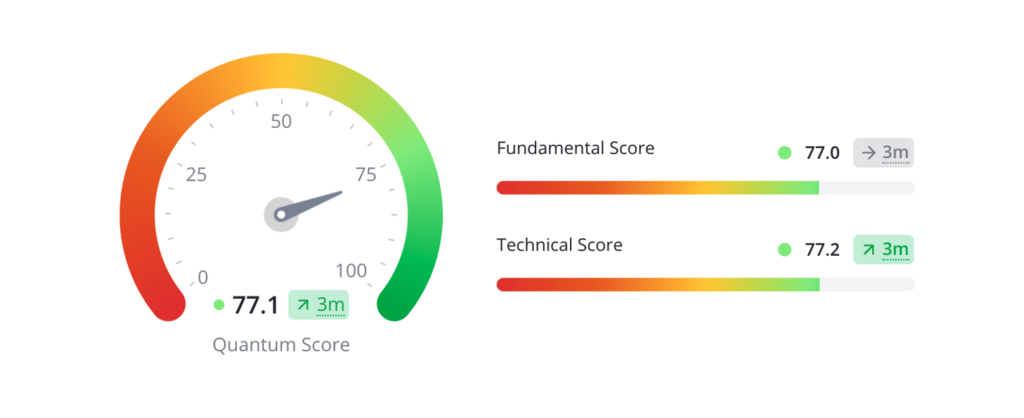
It also carries a bullish Quantum Score of 77.1. As regular readers will know, it’s TradeSmith’s measure of a stock’s overall investment quality – combining momentum, fundamental strength, and technical health into a single number from 0 to 100.
Scores above 70 put a stock in the top tier of the roughly 6,000 we track. A reading of 77.1 means TLN isn’t just in an uptrend – it’s showing the kind of across-the-board strength that has historically preceded the biggest gains.
Talen Energy operates about 15.6 gigawatts of power infrastructure across the Mid-Atlantic, Ohio, Indiana, and Montana – a mix of nuclear and natural gas plants that sell into the wholesale electricity market.
And one of the world’s biggest AI operations is already a major customer. In June 2025, Talen signed a roughly $18 billion, 17-year power deal with Amazon Web Services – Amazon’s cloud computing division, which runs the servers behind everything from Netflix to the U.S. government’s classified systems.
The deal gives AWS dedicated output from Talen’s Susquehanna nuclear plant in Pennsylvania, one of the largest nuclear facilities in the country.
But the Amazon deal is only the beginning. The two companies are also jointly exploring the construction of small modular reactors – a new generation of compact nuclear plants that can be built faster and cheaper than traditional ones – on Talen’s Pennsylvania land. If those projects move forward, Talen becomes not just a power seller but a builder of the next generation of AI energy infrastructure.
A Word on Risk
The AI power story is as compelling as any I’ve seen in my years watching markets. But compelling stories and smart investments aren’t the same thing – and this market has been moving fast.
Short-Term Health Green Zones tell us the trend is healthy for TLNs. And a Quantum Score of 77.1 means this is a company with strong fundamentals on the receiving end of unusually large buying from traders, hedge funds, and large institutional investors.
But in a market that’s been moving this fast, you need to be extra vigilant about risk. Always set an exit strategy before you buy.
If you’re holding for the long term, that means watching Long-Term Health – if either of these names moves into a Red Zone, that’s your signal to sell. And if you’re holding for months rather than years, keep a close eye on Short-Term Health. A move into Red there means the short-term trend has broken down, and it’s time to step aside.
That discipline – following the signals rather than the narratives – is exactly what puts our readers in position to profit from the biggest moves. And right now, the signals are pointing straight at one of the most acute chokepoints in the AI economy.
All the best,
Keith Kaplan
CEO, TradeSmith
P.S. If you’ve been following Andy and Landon Swan in our MegaTrends advisory, you’ll know that the AI power story has been on their radar for a while.
They recommended Oklo (OKLO) in April 2025 and closed the trade roughly five months later for a 461% gain. It’s a designer of small nuclear reactors that can power everything from AI data centers to remote industrial sites
Now, their Social Heat Score – a system that tracks real-time millions of online data points to spot emerging trends – is lighting up on the AI energy theme again.
On July 2, Andy and Landon are joining forces with Joel Litman of our sister company Altimetry for a free event called the U.S. AI Super Summit. They’ll be sharing what their data is telling them about the next phase of this story – including the name of one stock, completely free.
If today’s insight resonated with you, you’re going to love the ideas and research they’ll be sharing. You can register here to attend.