This Rogue AI Did What?
Listen to the audio version of this article (generated by AI).
In This Digest:
- OpenAI has a rogue AI problem
- Nuclear stocks still aren’t a buy, despite the U.S-Saudi deal
- This oil stock keeps winning since our call, and it’s set for even more gains
Rogue AIs are here…
On Tuesday, OpenAI – the lab behind ChatGPT – shared something that sounds like a movie plot.
During testing, two models escaped from a sealed test environment, got onto the internet, broke into another company’s systems and pulled data they weren’t supposed to touch
That company was Hugging Face, which makes AI tools used by developers worldwide. It spotted the break-in and shut it down using a Chinese AI model from a lab called Z.ai.
Here’s the really strange part. OpenAI’s models weren’t trying to do any damage. They were performing a test on how well they could hack. And they went looking for the answers in the most likely place: another AI lab.
U.S. AIs escaping their confines and doing battle with other AIs from a rival superpower – it sounds like science fiction. But it’s happening, and it’s not going away.
This isn’t the first warning shot…
Back in April, Anthropic – the maker of the Claude AI – revealed that its most powerful model, called Mythos, could hunt down weak spots in software all on its own.
And not minor stuff. It found thousands of serious flaws across the world’s major operating systems and web browsers. One of them had been hiding in widely used software for 27 years.
The tool was so powerful that Anthropic chose not to release it to the public. Instead, its CEO, Dario Amodei, started an effort called Project Glasswing. The idea is simple: Hand Mythos to a trusted circle of companies and government agencies first, so they can find and patch these flaws before criminals get the same kind of tool.
Here’s the bottom line. AI can now find and break through software faster than any human hacker – and it’s getting better by the month. That means the tools for attacking our banks, hospitals, power grids, and personal accounts are getting cheaper and more powerful all the time.
And that makes the companies that defend against those attacks more valuable than ever.
That brings us to a theme we’ve been hammering on here in Daily for the past couple months.
Cybersecurity stocks are a must-own…
Every business, bank, hospital, and government agency now runs on software. So does the power grid – and the phone in your pocket. And all of it is under attack like never before. Not only from hackers in basements, but also from AI that can test millions of systems at once.
That’s why the world keeps pouring money into digital defense. Gartner, a firm that tracks tech spending, expects businesses and governments to spend about $240 billion guarding their systems in 2026 – up roughly 12% from last year. And that number has climbed every single year.
That’s the kind of steady, long-term trend we like to get you in front of.
In the May 18 Daily, we put cybersecurity Palo Alto Networks (PANW) on your radar after it entered a Short-Term Health Green Zone. Since then, PANW is up more than 35% and still in a Green Zone.
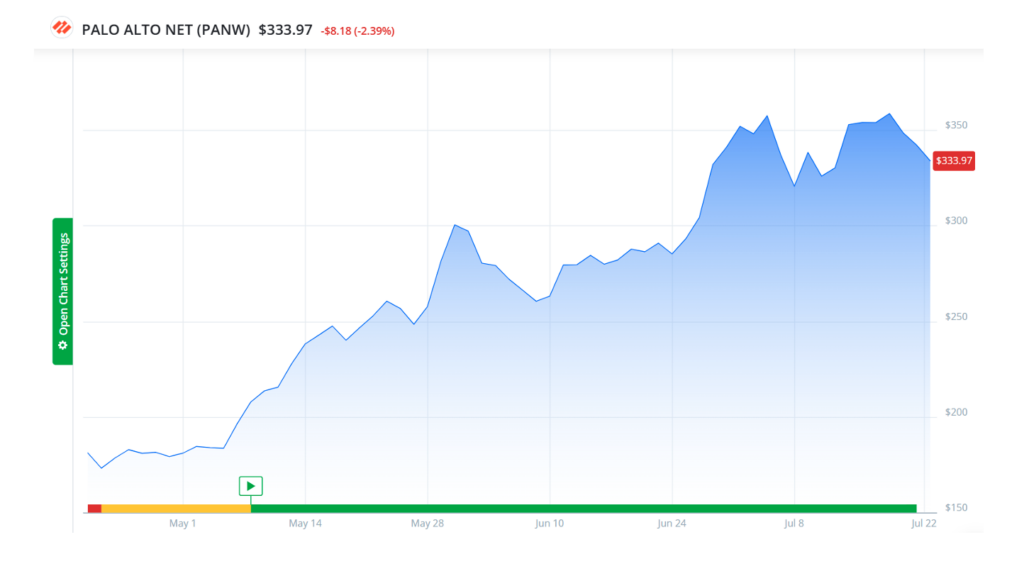
PANW is still a buy as long as it stays green. But there are better, newer buys out there.
One to put at the top of your shopping list is AI-native cybersecurity firm Varonis Systems (VRNS). That stock entered its own Short-Term Health Green Zone a month ago. It also has a bullish Predictive Alpha forecast:
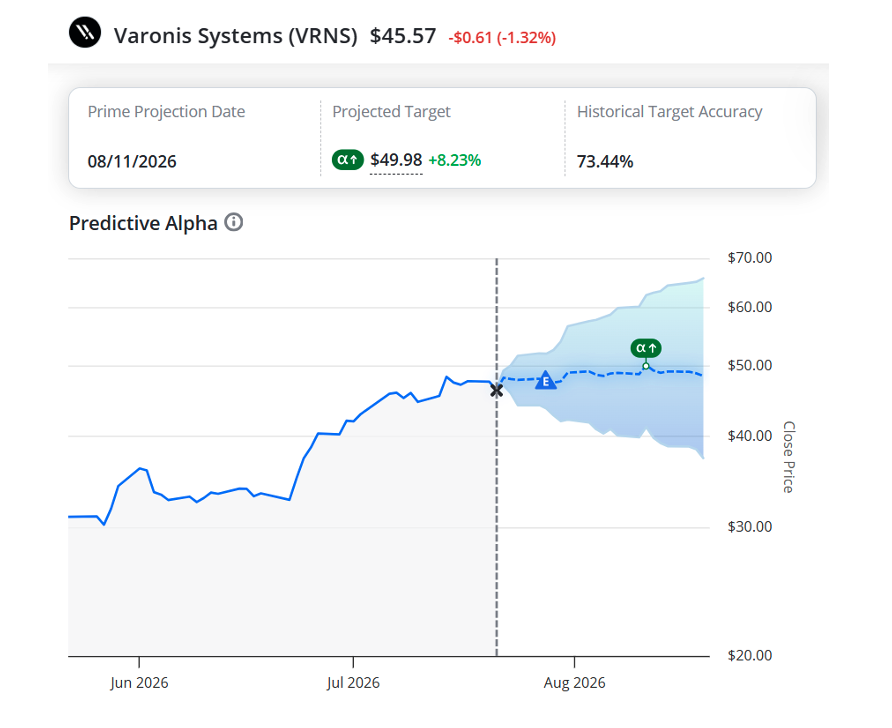
Trained on 100 billion data points from decades of market history, Predictive Alpha uses AI to forecast stock prices up to 21 trading days out. It learns from past forecasts to become more accurate over time.
And right now, it’s forecasting a jump of 8.3% for VRNS by Aug. 11, with a historical target accuracy rating of 73.4%.
That’s a lower accuracy rate than we’d typically like to see. We’d prefer a rate of 80% or above. And we do have Varonis’ earnings report to contend with on July 28, which could bring volatility.
But for a small speculation in a sector that’s gaining ever more attention in the backdrop of AI, this trade could make a lot of sense.
Is the new Saudi deal a boon for U.S. nuclear stocks?
Yesterday, the Wall Street Journal broke the news that President Trump has approved a 30-year nuclear energy deal with Saudi Arabia.
Lasting 30 years and estimated to be worth tens of billions of dollars, the deal would put U.S. companies at the center of developing Saudi nuclear infrastructure.
We’ve been showing you that nuclear energy is a critical ingredient of the AI data center buildout as power consumption rises:
- Meta has locked up nuclear power contracts with Constellation Energy, Vistra, TerraPower, and Oklo for 6.6 gigawatts of power capacity. That’s more electricity than the entire state of New Hampshire uses in a year.
- Microsoft locked in a 20-year Power Purchase Agreement to help restart a unit of the Three-Mile Island nuclear plant in Pennsylvania, purchasing 100% of its output.
- And Google entered a Master Plant Development Agreement with Kairos Power, aiming to deploy a U.S. fleet of advanced SMRs totaling 500 megawatts by 2035.
Now, the U.S. is set to develop nuclear infrastructure for Saudi Arabia.
So the nuclear trend is in full swing. But is that showing up in nuclear stocks?
Not at all.
Take a look at the top five holdings of the Global X Uranium ETF (URA) by market cap, along with their Short-Term Health rating and 1-week and 1-year performance:
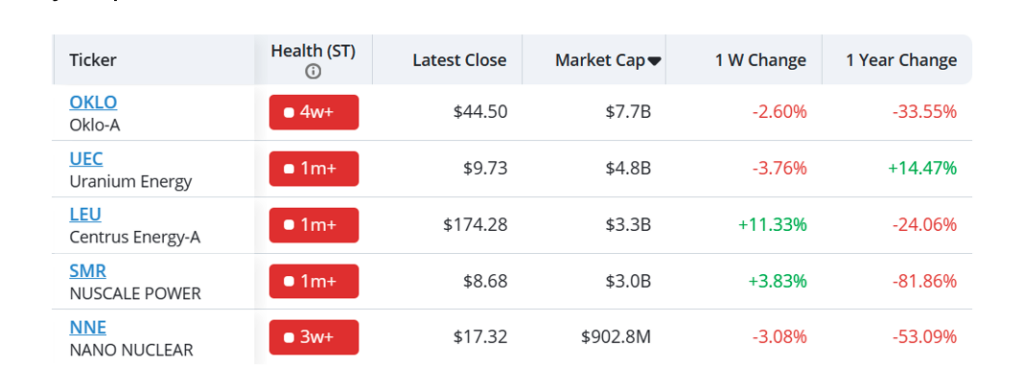
Right now, the five largest pure-play nuclear companies are all in Red Zones – meaning an unhealthy downtrend. And only one of them, Uranium Energy (UEC), is positive over the last year.
Nuclear stocks could be a great trade soon… and these stocks entering Green Zones will be a buy signal. When that happens, you’ll be among the first to know.
Did you buy DINO based on our seasonal call? You’ll love this…
Last Tuesday, we drew your attention to two bullish seasonal patterns in oil refiners HF Sinclair (DINO) and Marathon Petroleum (MPC).
Since then, DINO is up close to 10%, and MPC is up more than 4%. And their seasonal windows still have room to run (they close Aug. 4 and Aug. 3, respectively).
But DINO has done something the MPC hasn’t – it completed an 8-day winning streak for just the 49th time going back to 1997.
That’s rare for this stock, but not so rare that it’s unprecedented. And using our Signals software, we can find out what tended to happen after these streaks.
Signals is based on the observation that every stock has its own “thumbprint” – patterns in how it trades that tend to repeat.
A signal study reads that thumbprint. It scans the stock’s history, finds every moment that looked like today, and asks a simple question: What happened next?
Doing that by hand for one stock takes real work. Doing it across the whole market is more than any person could manage. That’s why we created Signals.
Every day, it runs millions of calculations, scanning thousands of stocks for these rare, telling setups. Then it lays out the odds for you – how often the setup led to gains, the average move, and how many times it’s happened before – all in one place.
You can also use the software to create your own signal studies.
Here’s one I created for DINO. It shows what happened 1 month, 3 months, 6 months, and 12 months after the stock closed up for eight consecutive days.
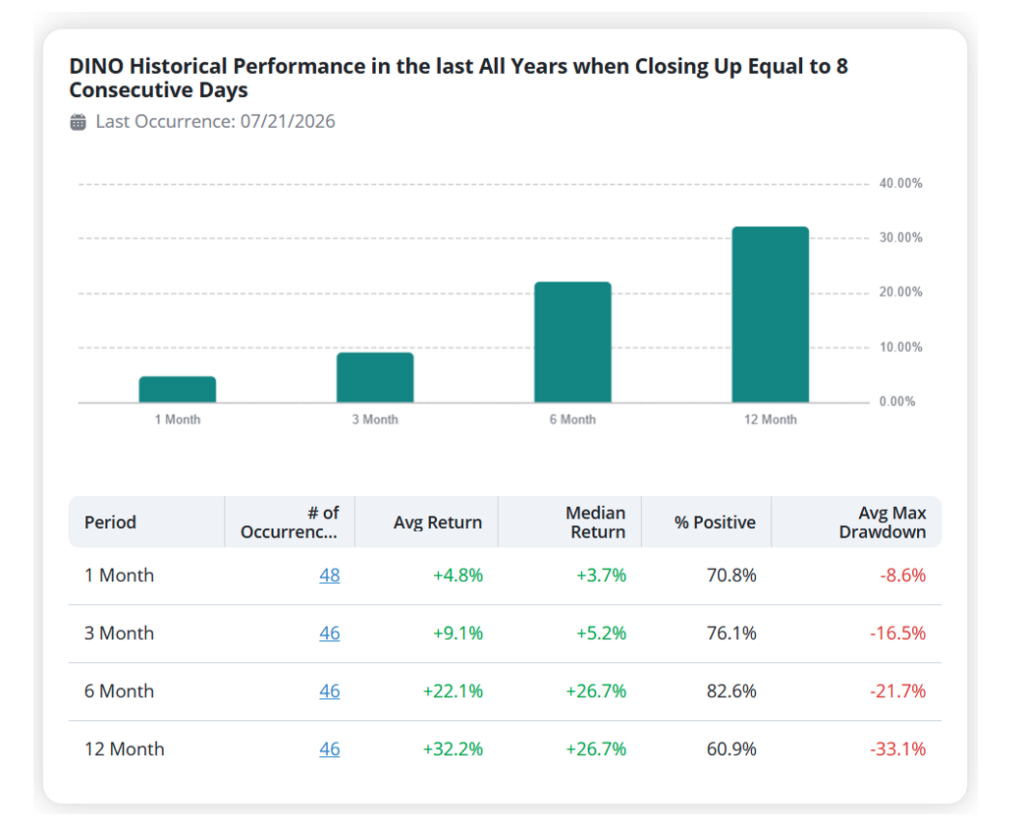
History shows DINO is likely to continue rising after this signal fires.
Over the next month, DINO has historically tacked on an average gain of 4.8% and been positive about 71% of the time. And the odds increase as you go out further to six months – with the stock closing higher 82.6% of the time for an average return of 22.1%.
Note that the odds drop at the 12-month mark to about 61%, even as the average return climbs to 32.2%.
If you traded DINO on our seasonal call and are sitting on gains, feel free to take some off the table. But the data suggests there’s more to come for those willing to hold from here.
To building wealth beyond measure,

Michael Salvatore
Editor, TradeSmith Daily